
Relocating to Spain or purchasing a vehicle from another country is an exciting venture, but it often comes with a significant amount of administrative hurdles. One of the most critical, yet frequently overlooked, components of this process is the "foreign car manufacturer’s plate," known in the Spanish legal and technical system as the placa de características coche extranjero. At Caerus Group, we specialize in helping car owners navigate the complexities of vehicle registration and homologation, ensuring that your transition to Spanish roads is as smooth as possible.
When you bring a vehicle into Spain, whether it is from within the European Union or from a third country, the Spanish authorities require specific technical data to verify that the vehicle meets safety and environmental standards. This data is primarily sourced from the manufacturer’s identification plate. Understanding what this plate is, where to find it, and why it is indispensable for your "ITV" (Inspección Técnica de Vehículos) is essential for any successful registration.
What is a Foreign Car Manufacturer’s Plate?
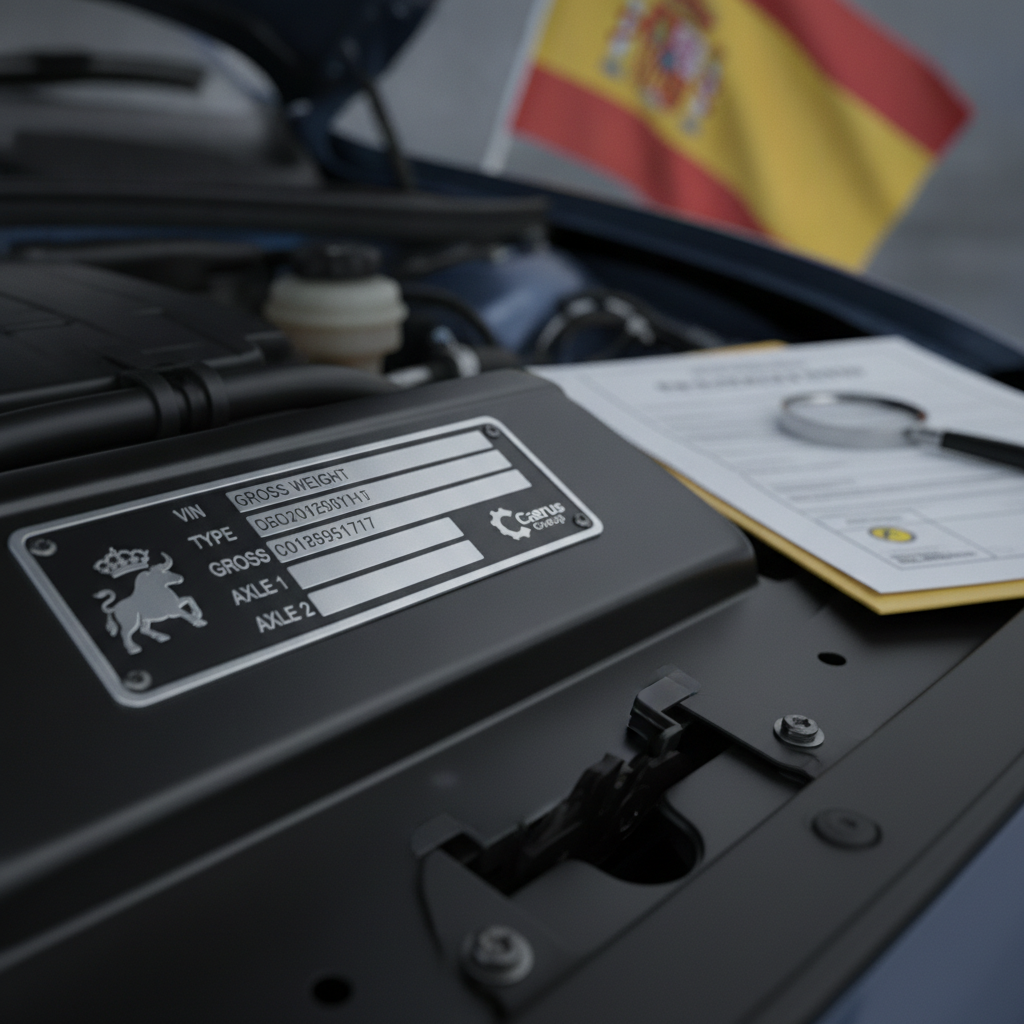
The placa de características coche extranjero is a small metal plate or a high-resistance sticker affixed to the vehicle’s chassis by the manufacturer. Unlike the simple VIN (Vehicle Identification Number) plate that is often visible through the windshield, the manufacturer’s plate contains a comprehensive set of technical data required by European law. This includes the manufacturer’s name, the whole-vehicle type-approval number (if applicable), the VIN, and the maximum authorized weights for the vehicle and its axles.
For vehicles imported to Spain, this plate serves as the "birth certificate" of the car’s technical specifications. It allows the technicians at the inspection centers to cross-reference the physical vehicle with the documentation provided, such as the original registration certificate or the Certificate of Conformity (CoC). Without a legible and valid manufacturer's plate, the process of obtaining a Spanish "Ficha Técnica" (Technical Sheet) can become significantly more complicated and expensive.
The Importance of the Identification Plate in the ITV Inspection
In Spain, every imported vehicle must undergo a "non-periodic" ITV inspection specifically for registration purposes. During this inspection, the engineer will closely examine the placa de características coche extranjero. They are looking for several key pieces of information that determine if the car can be legally driven in Spain. If the plate is missing, damaged, or does not match the provided documents, the vehicle will fail the inspection immediately.
The primary reason this plate is so vital is the "homologation" process. For cars coming from within the EU, the plate usually features an "e" followed by a number in a rectangle, which signifies European Type Approval. This indicates that the vehicle was manufactured to meet EU-wide standards. If your car is from outside the EU, such as the United States or the United Arab Emirates, the plate will look different, and you may need a "Unitary Homologation" or a reduced technical file, a process where Caerus Group excels in providing expert guidance.
The Legal Framework and Necessary Documentation
The registration of foreign vehicles in Spain is governed by strict regulations set by the Ministry of Industry and the Dirección General de Tráfico (DGT). To complete the registration, you will need more than just the physical plate on the car. You will also need the original foreign registration documents, proof of ownership (such as a sale contract or invoice), and proof of payment for the various Spanish taxes involved.
The taxes typically include the IEDMT (Impuesto Especial sobre Determinados Medios de Transporte), which is based on the vehicle’s CO2 emissions, and the IVTM (Impuesto de Vehículos de Tracción Mecánica), which is the local road tax. The technical data found on your placa de características coche extranjero is often used to calculate these emissions and weights, directly impacting the amount of tax you will owe. Ensuring this data is accurately transcribed into your Spanish paperwork is a core part of the service we provide at Caerus Group.
Common Challenges with Foreign Vehicle Plates
Throughout our years of experience at Caerus Group, we have encountered various challenges regarding the placa de características coche extranjero. One common issue is when a vehicle has been repainted or repaired after an accident, and the plate has been removed or painted over. In such cases, the owner must contact the original manufacturer to request a replacement plate or a certified technical letter, which can take weeks or even months.
Another challenge arises with vintage or classic cars. Older vehicles may not have a standardized manufacturer's plate that meets modern Spanish requirements. For these vehicles, we must pursue a "Historical Vehicle" registration, which involves a different set of rules and a specialized laboratory inspection. Regardless of the age or origin of your vehicle, having a professional team to inspect your vehicle's physical plates before you head to the ITV station can save you significant time and money.
How Caerus Group Simplifies Your Registration Process
At Caerus Group, we understand that the technicalities of car registration can be overwhelming. Our mission is to handle the bureaucracy so you can enjoy your vehicle on the beautiful Spanish roads. Our comprehensive service includes a preliminary review of your placa de características coche extranjero to ensure it meets all the requirements of the Spanish ITV stations. We identify potential issues before they become costly failures.
Our team manages the entire workflow: from the initial technical consultation and the preparation of reduced technical files to the final appointment at the DGT for your new Spanish license plates. We act as your liaison with engineers, tax offices, and traffic authorities. By choosing Caerus Group, you are choosing a partner that understands the nuances of foreign vehicle specifications and the local legal landscape.
Conclusion: Moving Forward with Confidence
Importing a car to Spain doesn't have to be a stressful experience. By paying attention to the details, such as the placa de características coche extranjero, and seeking professional assistance, you can ensure a successful registration. This small plate is a fundamental bridge between your car’s foreign origin and its new life in Spain, serving as the ultimate proof of its identity and technical integrity.
If you are planning to bring a vehicle to Spain or are currently struggling with the registration process, contact Caerus Group today. Our experts are ready to assist you with every step, from analyzing your vehicle's manufacturer plate to handing over your new Spanish registration documents. Let us take the wheel of the administrative process while you focus on the journey ahead.