
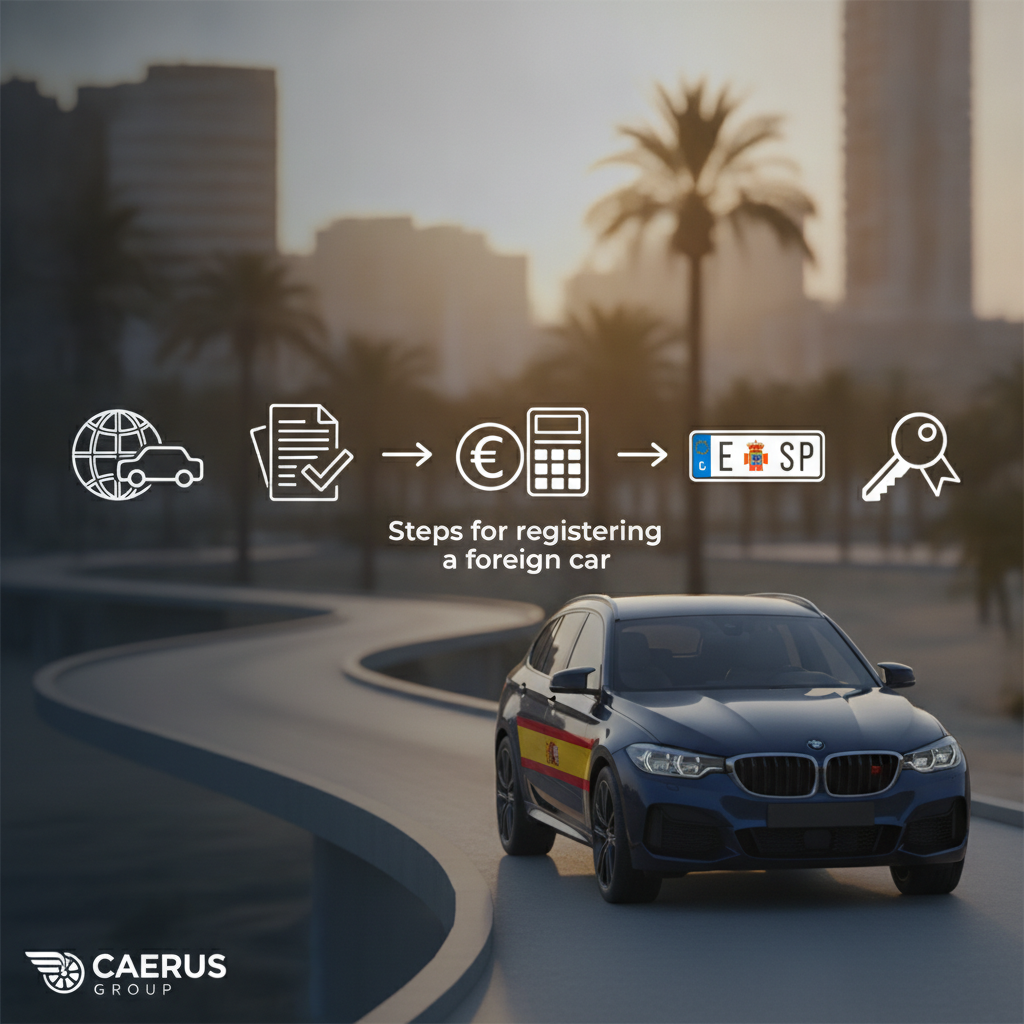
Relocating to Spain or purchasing a luxury vehicle from another European country is an exciting milestone. However, the excitement often meets the reality of administrative complexity. At Caerus Group, we understand that your time is valuable and that the Spanish bureaucratic system can be daunting for those unfamiliar with the specific requirements of the Dirección General de Tráfico (DGT) and the Tax Agency. Whether you have brought your car from Germany, France, or even outside the European Union, there is a specific legal path you must follow to drive legally on Spanish roads.
Navigating the Bureaucracy: Why Professional Management Matters
The process of legalizing a foreign vehicle involves multiple government bodies, various tax payments, and technical inspections. Many vehicle owners attempt to handle this process independently, only to find themselves stuck in a loop of missing documents or incorrect tax filings. Caerus Group specializes not only in high-quality vehicle sales but also in comprehensive registration services. We ensure that every vehicle meets Spanish standards and that all duties are paid correctly, saving you from potential fines or legal delays.
When you decide to bring a car into the country, you are essentially "nationalizing" it. This requires a transition from the origin country’s regulations to the Spanish legislative framework. Below, we break down the essential steps to register a foreign car (the English equivalent of the "pasos para matricular coche extranjero") to help you understand what to expect during this transition.
The Essential Steps to Register a Foreign Car in Spain
1. Technical Inspection (ITV)
The first physical step for any vehicle arriving in Spain is passing the Inspección Técnica de Vehículos (ITV). Unlike a standard annual inspection, this is a "non-periodic" inspection for the purpose of issuing a Spanish Technical Sheet (Ficha Técnica). You will need to provide the original vehicle documentation from the country of origin. If the vehicle does not have a European Certificate of Conformity (CoC), you may need a "Ficha Reducida," which is a technical document signed by a qualified engineer detailing the car's specifications.
2. Payment of the Registration Tax (IEDMT)
One of the most critical steps to register a foreign car is settling your obligations with the Spanish Tax Agency. The Impuesto Especial sobre Determinados Medios de Transporte (IEDMT) is calculated based on the vehicle's CO2 emissions. Vehicles with lower emissions may be exempt, while high-performance or older cars may face higher rates. This is handled via Model 576 on the Tax Agency's website. You can find detailed information on tax brackets and valuations on the official Agencia Tributaria website.
3. Payment of the Municipal Road Tax (IVTM)
In addition to the national registration tax, you must pay the Impuesto de Vehículos de Tracción Mecánica (IVTM) to the local town hall (Ayuntamiento) where you are registered as a resident. The cost varies significantly depending on the municipality and the horsepower (CVF) of the vehicle. You must keep the receipt of this payment, as the DGT will require it to finalize the registration.
4. Application for Registration at the DGT
Once the technical inspection is passed and the taxes are paid, the file must be submitted to the DGT. You will need to provide your ID (DNI or NIE), proof of residence (empadronamiento), the original foreign registration documents, and the proof of tax payments. The DGT will then issue a new Spanish registration number and the official "Permiso de Circulación."
5. Ordering Plates and Insurance
With your new registration number in hand, the final physical step is to have Spanish license plates manufactured and fitted to your vehicle. Simultaneously, you must secure a Spanish insurance policy. It is illegal to drive a Spanish-registered vehicle with foreign insurance once the registration process is complete.
Common Challenges and How Caerus Group Can Help
While the steps to register a foreign car seem straightforward on paper, complications often arise. For instance, vehicles imported from outside the EU (such as the USA or UK) require a customs clearance document (DUA) and may need technical modifications to comply with EU safety and lighting standards. Furthermore, the valuation of the vehicle for tax purposes can be tricky; if undervalued, the Tax Agency may issue a penalty later.
At Caerus Group, we act as your dedicated gestoría and consultant. We handle the communication with engineers for the Ficha Reducida, book the ITV appointments, calculate the most efficient tax path, and process the final paperwork with the DGT. Our goal is to hand you your Spanish plates and your Permiso de Circulación without you having to step foot in a government office.
Conclusion: Drive With Peace of Mind
Registering a foreign vehicle is a mandatory requirement if you plan to keep the car in Spain for more than six months (or if you become a legal resident). Delaying this process can lead to the impounding of the vehicle and heavy financial penalties. By following the steps to register a foreign car outlined above, you ensure that your investment is protected and your legal standing in Spain is secure.
If you have recently moved to Spain or have purchased a vehicle abroad, let the experts at Caerus Group manage the heavy lifting. We pride ourselves on transparency, speed, and professional excellence in both car sales and administrative services. Contact us today to receive a personalized quote for your vehicle registration and enjoy the Spanish roads with total peace of mind.