
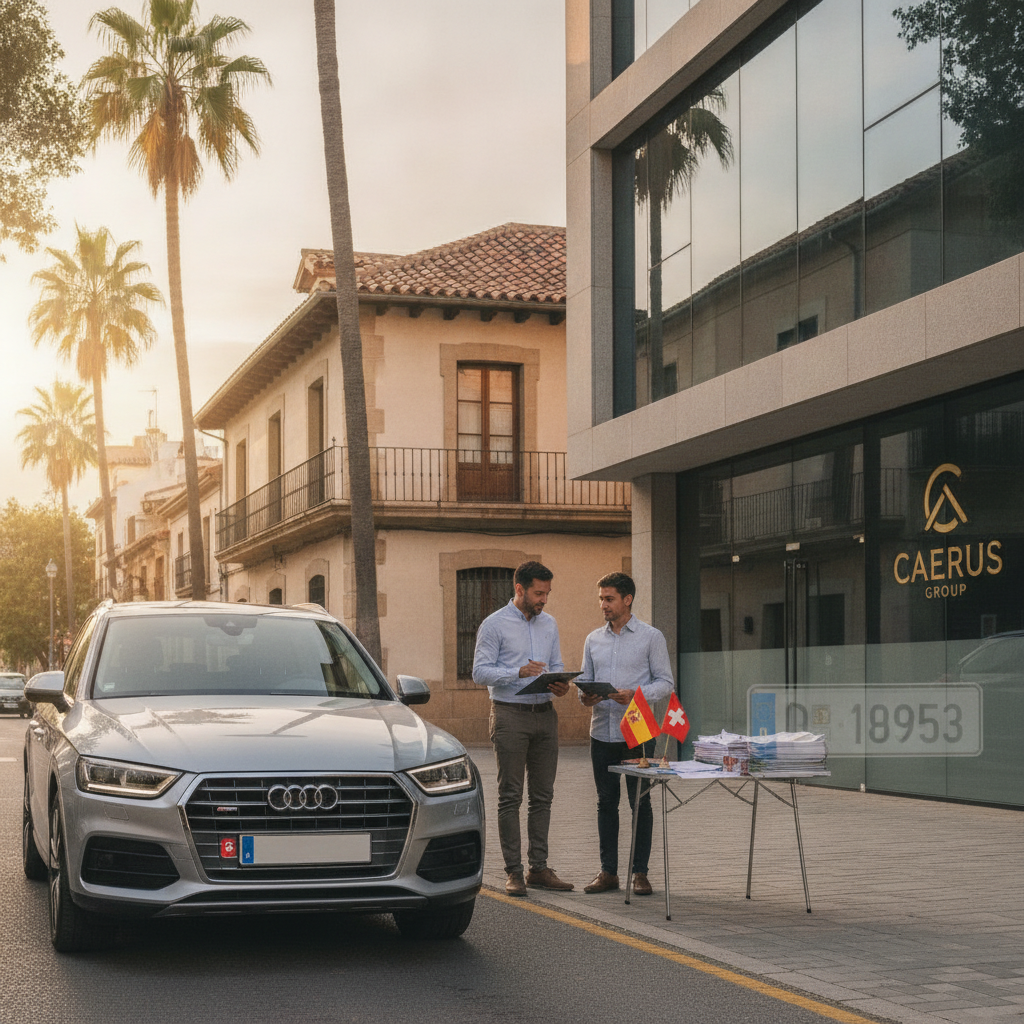
Relocating from the pristine landscapes of Switzerland to the sunny shores of Spain is an exciting journey. However, for car enthusiasts and expatriates, one of the most daunting tasks is bringing their vehicle along. Because Switzerland is not a member of the European Union—despite being part of the Schengen Area—the process of importing and deciding to register a car from Switzerland in Spain involves specific customs procedures and tax regulations that differ from importing a car from Germany or France.
At Caerus Group, we specialize not only in offering premium vehicles but also in managing the complex administrative hurdles of vehicle registrations. In this comprehensive guide, we will walk you through the essential steps, costs, and documentation required to ensure your Swiss vehicle is legal on Spanish roads.
Understanding the Legal Framework
The first thing to understand is that Switzerland is considered a third country in the eyes of the European Union's customs union. This means that your vehicle must go through a formal importation process. You cannot simply drive across the border and change the plates. The process involves clearing customs, paying the relevant duties, and then proceeding with the standard Spanish registration "matriculación" process.
If you are moving to Spain permanently, there is good news. You may be eligible for a tax exemption based on a "change of residence." To qualify for this, you must have owned the vehicle for at least six months prior to moving and have lived in Switzerland for at least twelve months. This exemption can save you thousands of euros in VAT and registration taxes.
Step 1: Customs Clearance and the DUA
The very first step to register a car from Switzerland in Spain is the customs office. You must present the vehicle at the Spanish border or a designated customs point to file the Single Administrative Document (Documento Único Administrativo or DUA). This document is the official declaration of import.
Unless you qualify for the aforementioned change of residence exemption, you will typically be required to pay 21% VAT (IVA) on the current value of the car, plus a 10% import duty. For accurate valuations, the Spanish Tax Agency provides tables, but for unique or high-end models, a professional appraisal might be necessary. You can find more information on official import regulations at the Agencia Tributaria website.
Step 2: Technical Inspection (ITV)
Once the car has cleared customs, it must pass a Spanish Technical Inspection (Inspección Técnica de Vehículos or ITV). This is not a standard annual check; it is a "non-standard" inspection for vehicle homologation. The engineers will verify that the car meets Spanish and EU safety and environmental standards.
To facilitate this, you will need the Certificate of Conformity (CoC). If your Swiss vehicle was originally manufactured for the European market, obtaining a CoC from the manufacturer is straightforward. If the vehicle does not have a CoC, you may need a "Ficha Técnica Reducida," a document prepared by a specialized engineer that details the technical specifications of the car. Caerus Group frequently assists clients in sourcing these documents to prevent delays at the inspection station.
Step 3: Paying Spanish Registration Taxes
After passing the ITV, you will receive your new Spanish technical sheet. Now it is time to settle your taxes with the Spanish government. There are two main taxes to consider:
1. Impuesto Especial sobre Determinados Medios de Transporte: Commonly known as the registration tax. This is calculated based on the car's CO2 emissions. Cars with zero or very low emissions may be exempt, while high-emission vehicles can face a tax rate of up to 14.75% of the vehicle's value.
2. Impuesto de Circulación (IVTM): This is a local municipal road tax paid to the town hall (Ayuntamiento) where you are registered as a resident. The cost varies depending on the horsepower of the vehicle and the specific municipality.
Step 4: Final Registration at the DGT
The final administrative step to register a car from Switzerland in Spain takes place at the Dirección General de Tráfico (DGT). You will need to submit all the previously gathered documentation, including the DUA, the ITV certificate, proof of tax payments, and your personal identification (NIE/DNI and proof of address/Empadronamiento).
Once the DGT processes the application, they will assign you a Spanish registration number. You can then purchase your physical license plates and attach them to your vehicle. At this point, you must also ensure you have a valid Spanish insurance policy, as Swiss insurance will no longer be valid for a Spanish-registered vehicle.
Why Choose Caerus Group for Your Registration?
Attempting to register a car from Switzerland in Spain on your own can be an exhausting experience involving multiple government departments, language barriers, and complex tax calculations. One mistake in the paperwork can lead to your car being stuck in customs or failing its inspection.
At Caerus Group, we offer a "turnkey" service. We handle the customs agents, the engineering reports for the ITV, the tax filings, and the final DGT appointments. Our deep understanding of both the automotive market and Spanish bureaucracy allows us to expedite the process, ensuring you can enjoy your vehicle on Spanish roads as quickly as possible.
Whether you are bringing a luxury SUV from Zurich or a classic sports car from Geneva, our team is equipped to handle the logistics. We pride ourselves on transparency and efficiency, taking the weight off your shoulders so you can focus on settling into your new life in Spain.
Conclusion
While the process to register a car from Switzerland in Spain is more involved than a standard EU transfer, it is perfectly manageable with the right preparation. By understanding the importance of the DUA, the requirements of the ITV, and the nuances of the Spanish tax system, you can successfully navigate the importation of your Swiss vehicle.
If you are looking for professional assistance or are considering purchasing a vehicle already registered in Spain, contact Caerus Group today. We are your trusted partner for all things automotive in Spain, from sales to complex registrations.