
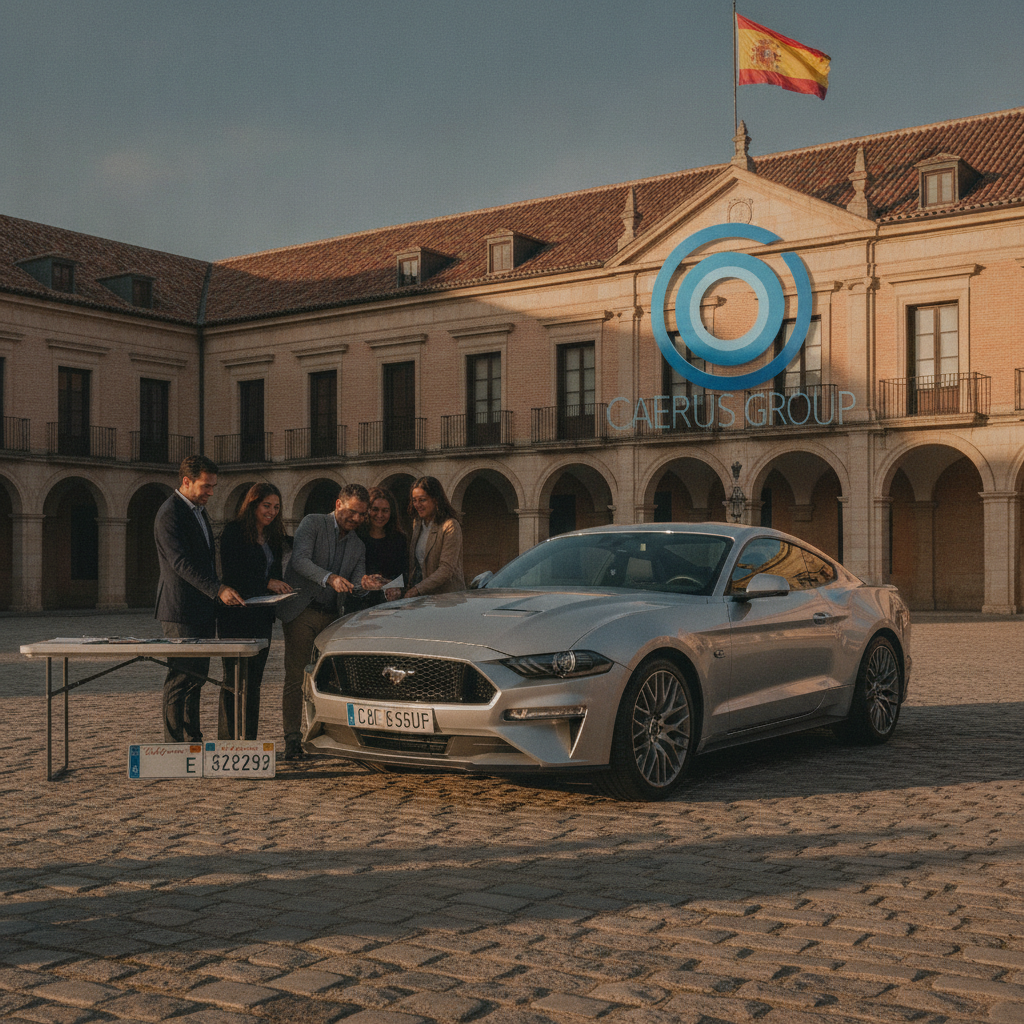
Bringing a vehicle from the United States to the sun-drenched roads of Spain is a dream for many automotive enthusiasts. Whether it is a classic Ford Mustang, a powerful Chevrolet Silverado, or a high-tech Tesla with American specifications, the allure of US-market vehicles is undeniable. However, the process of importing and successfully registering a car from the United States in Spain is a complex journey filled with technical hurdles, administrative paperwork, and specific tax obligations. At Caerus Group, we specialize in making this transition seamless, ensuring that your American dream doesn't turn into a bureaucratic headache.
Navigating the Import Process: First Steps at the Port
The journey of registering a car from the United States in Spain begins long before the vehicle hits the Spanish highways. Once your car arrives at a Spanish port—typically Valencia, Barcelona, or Algeciras—it must clear customs. This is a critical stage where the Documento Único Administrativo (DUA) is generated. This document acts as the vehicle's "birth certificate" in the European Union.
During this stage, you are required to pay the relevant import duties. Generally, for passenger vehicles, there is a 10% import duty based on the current value of the car plus the shipping costs. Additionally, you must settle the Value Added Tax (IVA), which stands at 21% in Spain. It is important to note that if you are moving to Spain as a permanent resident and bringing your personal vehicle as part of your household move, you may be eligible for certain tax exemptions, provided you meet the strict criteria set by the Spanish Tax Agency (Agencia Tributaria).
Technical Homologation: Meeting European Standards
One of the most significant challenges in registering a car from the United States in Spain is technical homologation. Vehicles manufactured for the American market follow different safety and environmental standards than those produced for the European Union. To be legal on Spanish roads, your car must undergo a process called "Homologación Individual" (Individual Vehicle Approval).
This process often requires physical modifications to the vehicle. For instance, US cars typically have red rear turn signals, whereas European regulations mandate amber ones. Additionally, you may need to install a rear fog light, adjust the beam pattern of the headlights, and ensure the speedometer displays kilometers per hour. At Caerus Group, we work with specialized engineers who oversee these modifications, ensuring that your vehicle complies with every detail of Spanish law without compromising its original character.
The ITV Inspection: The Technical Green Light
Once the vehicle has been modified and the engineering project is ready, the next step is the Inspección Técnica de Vehículos (ITV). This is not a standard annual inspection; it is an extraordinary "non-standard" inspection for imported vehicles. The inspectors will verify that the modifications listed in the homologation project have been carried out correctly and that the vehicle meets all safety and emissions standards.
This step is often where DIY importers face the most difficulty. If the paperwork is not exactly right, or if a minor technical detail is overlooked, the vehicle will fail, leading to costly delays. By trusting Caerus Group, you benefit from our deep understanding of ITV requirements, as we pre-screen every vehicle to ensure it passes on the first attempt.
Calculating Registration Taxes and Local Fees
After passing the ITV, you will receive your Spanish technical sheet (Ficha Técnica). With this in hand, it is time to face the Spanish tax system once again. The most significant fee at this stage is the Impuesto Especial sobre Determinados Medios de Transporte (IEDMT), commonly known as the Registration Tax. This tax is calculated based on the vehicle's CO2 emissions. For high-emission American engines, this tax can be substantial, sometimes reaching 14.75% of the vehicle's value.
Furthermore, you must pay the Impuesto de Vehículos de Tracción Mecánica (IVTM), which is the annual road tax paid to the local town hall (Ayuntamiento) where you reside. The amount varies depending on the horsepower of the vehicle and the specific municipality. Managing these payments accurately is essential to avoid penalties and to move forward to the final stage of the registration process.
Final Step: Registration with the DGT
The final hurdle in registering a car from the United States in Spain is the formal application with the Dirección General de Tráfico (DGT). You must submit all previously gathered documentation: the DUA, the proof of tax payments, the ITV technical sheet, and proof of ownership. Once processed, the DGT will assign your vehicle a Spanish license plate number and issue the "Permiso de Circulación" (Circulation Permit).
Only after receiving this document and fitting your new Spanish plates can you legally drive your American car on public roads. It is also the moment to secure a Spanish insurance policy, as US insurance is not valid for locally registered vehicles.
Why Partner with Caerus Group?
The process described above involves multiple government agencies, complex engineering requirements, and significant financial transactions. For an individual, this can take months of frustration. Caerus Group was founded to provide a comprehensive solution for car enthusiasts and expats alike. We are not just a dealership; we are your administrative partner in Spain.
We handle everything from the moment the container arrives at the port to the moment you turn the key in your newly registered vehicle. Our team manages the customs clearance, coordinates with specialized workshops for homologation, oversees the ITV inspection, and files all tax returns on your behalf. We understand that your vehicle is more than just a mode of transport; it is a passion. Our goal is to protect that passion by providing a transparent, efficient, and professional service.
If you are considering importing and registering a car from the United States in Spain, do not leave it to chance. Contact Caerus Group today, and let our experts guide you through the fast lane of Spanish vehicle registration.