
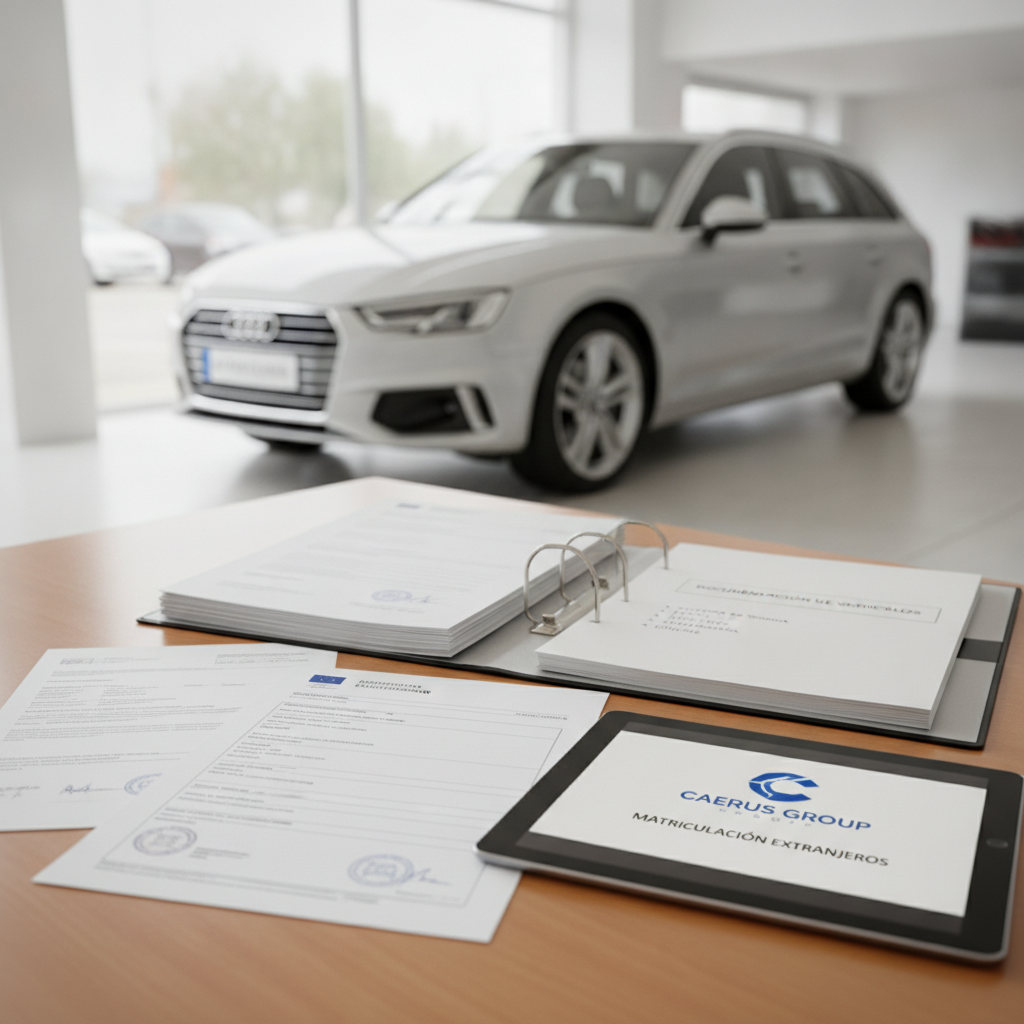
Buying a car in Germany, France, Italy, or any other member state of the European Union is an increasingly popular choice for residents in Spain. Whether you are looking for a specific luxury model, a classic vehicle, or a better price deal than what is available locally, the European market offers vast opportunities. However, the excitement of a new purchase can quickly be overshadowed by the complexities of Spanish bureaucracy. At Caerus Group, we specialize not only in premium vehicle sales but also in comprehensive registration services to ensure your transition to Spanish roads is seamless and stress-free.
Understanding the Importance of Correct Paperwork
Bringing a vehicle from a member state of the European Union into Spain involves navigating several administrative layers. While the process is significantly easier than importing a car from outside the EU (such as from the United States or post-Brexit UK), it still requires a specific and meticulous set of paperwork. Having the correct documentation for registering a car from the EU is the essential difference between driving your new vehicle within a few weeks or facing months of frustrating delays, technical rejections, and potential fines.
The Spanish authorities, specifically the Directorate General for Traffic (DGT) and the Tax Agency (Hacienda), are exceptionally strict regarding the validity, format, and translation of foreign documents. At Caerus Group, we have years of experience managing these complexities, ensuring that every stamp and signature is in place before the process even begins.
Essential Documentation for Registering a Car from the EU
To start the legalization process in Spain, you must gather several key pieces of information. If any of these items are missing, the process will come to a halt. Here is the definitive list of the documentation for registering a car from the EU that you will need to provide:
1. Proof of Identity and Residency: You must provide a valid ID recognized by the Spanish authorities. For Spanish citizens, a DNI is sufficient. For foreigners, you will need your valid passport along with your NIE (Número de Identidad de Extranjero). Additionally, you must prove your residency in Spain using a rental contract, property deeds, or a recent certificate of "Empadronamiento" from your local town hall.
2. Original Vehicle Documents: You must have the original registration certificate from the country of origin. For example, if the car is from Germany, you need both parts of the "Fahrzeugbrief" (Teil I and Teil II). If it is from France, the "Certificat d’immatriculation" is required. These documents serve as proof of the car's technical history and previous ownership status.
3. Proof of Purchase or Ownership: The requirements change depending on how you acquired the vehicle. If you bought the car from a professional dealership, you need the original invoice which must clearly show the company’s VAT (IVA) number. If it was a private sale between individuals, you need a sales contract translated into Spanish and proof of payment of the Property Transfer Tax (ITP).
4. Certificate of Conformity (COC): This is perhaps the most critical part of the documentation for registering a car from the EU. The COC is a document issued by the manufacturer that confirms the vehicle meets the technical and safety standards required by the European Union. It includes data on CO2 emissions, which is vital for calculating Spanish taxes. If your vehicle does not have a COC, you will likely need a "Ficha Reducida" (a reduced technical sheet) prepared by a certified Spanish engineer.
The Step-by-Step Registration Process
Once you have gathered the necessary documentation for registering a car from the EU, the physical and administrative process begins. It is not as simple as showing up at an office; it involves several technical and financial hurdles that must be cleared in a specific order.
Step 1: The Technical Inspection (ITV)
Even if your car has a valid MOT from the UK, a TÜV from Germany, or a CT from France, it must pass a Spanish ITV (Inspección Técnica de Vehículos). This is a "non-periodic" inspection specifically designed for registration. The engineers will verify that the car’s physical characteristics match the technical specifications listed in your documentation. They will then issue a Spanish Technical Sheet (Tarjeta de ITV).
Step 2: Settling Your Tax Obligations
Before you can be issued Spanish license plates, you must settle your accounts with the Tax Agency. The most significant cost is the Registration Tax (Impuesto de Matriculación), which is calculated based on the car's CO2 emissions. Cars with lower emissions pay less, while high-emission vehicles can be taxed significantly. Additionally, you must pay the annual Road Tax (IVTM) to the local town hall where you are registered. For more detailed information on official rates and traffic regulations, you can visit the official Dirección General de Tráfico (DGT) website.
Step 3: Final Submission to the DGT
With the ITV passed and all taxes paid, the final step is to submit the complete dossier of documentation for registering a car from the EU to the DGT. Once approved, they will issue your new Spanish registration number and the "Permiso de Circulación". At this point, you can finally purchase your Spanish plates and insure the vehicle with a Spanish provider.
Common Pitfalls and How Caerus Group Can Help
Many individuals attempt to handle this process alone to save money, only to find that a single missing document or an incorrect tax calculation leads to much higher costs. For instance, incorrectly filling out "Model 576" for the Tax Agency can result in heavy penalties. Furthermore, calculating the depreciation value of a used vehicle requires expert knowledge of the official tables published in the BOE (Official State Gazette).
At Caerus Group, we offer a comprehensive "turnkey" solution. We manage the collection of all documentation for registering a car from the EU, schedule and attend the ITV appointments, calculate the most favorable tax scenarios for you, and handle all communications with the DGT. We take the weight of Spanish bureaucracy off your shoulders, allowing you to enjoy your vehicle without the headache of paperwork.
Conclusion
Navigating the legal requirements and the necessary documentation for registering a car from the EU does not have to be a nightmare. By understanding the need for the COC, the importance of the Spanish ITV, and the specific tax obligations of your region, you are already better prepared than most. However, for total peace of mind and a professional result, trusting the experts is always the safest route.
Whether you are moving to Spain and bringing your personal car with you, or you have just purchased a vehicle abroad, Caerus Group is here to help. Contact us today to learn more about our registration services and how we can get your European car legally on Spanish roads with zero hassle.