
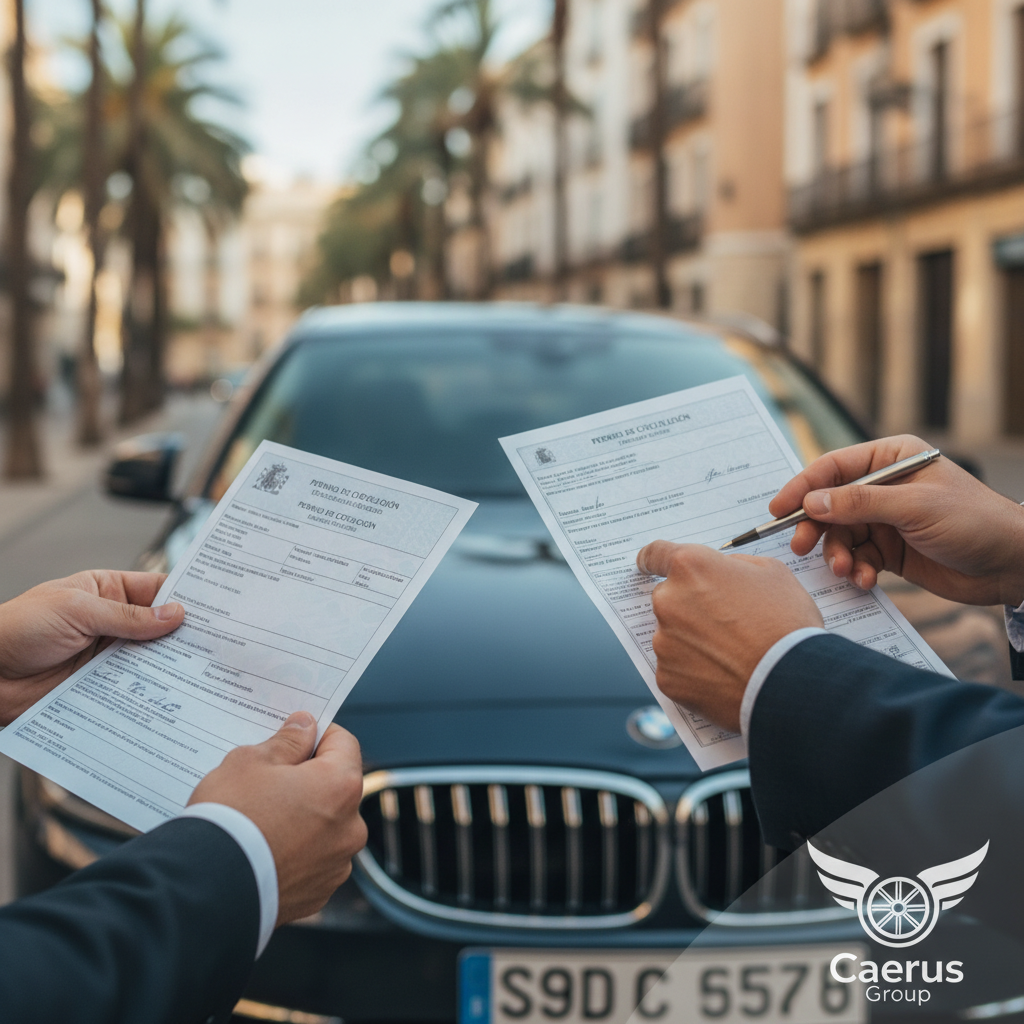
Relocating to Spain or purchasing a vehicle from another European country is an exciting milestone. However, the administrative procedures required to legalize a foreign vehicle can often feel like a bureaucratic maze. One of the most frequent and complex questions we encounter at Caerus Group is: How to register a foreign car if I am not the owner? While the process is generally designed for the person whose name appears on the original vehicle documents, there are specific legal avenues and requirements that allow a third party or a new buyer to handle the registration in Spain.
At Caerus Group, we specialize not only in high-quality vehicle sales but also in comprehensive registration services. We understand that life situations vary—perhaps you are registering a car for a family member, acting on behalf of a company, or you have recently purchased a car abroad and the foreign title has not yet been updated. In this article, we will break down the legal requirements, the documentation needed, and the steps you must take to successfully register a foreign vehicle in Spain under these circumstances.
Is it Legal to Register a Car You Don’t Officially Own Yet?
The short answer is yes, but with significant caveats. In the eyes of the Spanish authorities, specifically the Dirección General de Tráfico (DGT), the person registering the vehicle must prove their "title of acquisition" or their legal right to represent the owner. If you are asking yourself how to register a foreign car if I am not the owner, you must understand that the DGT requires a clear paper trail connecting the current foreign owner to the person initiating the registration in Spain.
This situation typically arises in two scenarios. First, when a professional "gestoría" or a company like Caerus Group acts as an authorized representative. Second, when an individual has purchased a vehicle and possesses a sales contract or invoice, but the foreign registration certificate (the "logbook" or "Permiso de Circulación") still displays the previous owner's name. In both cases, the Spanish administration allows the process to proceed as long as the change of ownership and the importation are handled simultaneously.
Key Documentation for Non-Owner Registration
To navigate the process of how to register a foreign car if I am not the owner, you will need a robust set of documents. Missing even one can lead to delays or the rejection of your application. The following are the essential items required by the Spanish Tax Agency and the DGT:
1. Proof of Identity: You will need your NIE (Número de Identidad de Extranjero) or DNI, along with a valid passport. If you are representing a company, the CIF of the company and the deeds of incorporation are required.
2. Original Foreign Documentation: You must present the original vehicle registration document from the country of origin (e.g., the V5C from the UK, the Certificat d’Immatriculation from France, or the Fahrzeugbrief from Germany).
3. The Title of Acquisition: This is the most critical piece for those who are not yet listed as the owner. If you bought the car from a professional dealer, you need an invoice including the VAT (IVA) number. If it was a private sale, you need a bilingual sales contract signed by both parties and a copy of the seller’s ID.
4. Power of Attorney: If you are registering the car for someone else without having purchased it (for example, for a relative), you must have a signed authorization or a formal power of attorney (mandato) allowing you to act on their behalf before the DGT.
5. Certificate of Conformity (COC): This document proves the vehicle meets European technical standards. If you don’t have it, a "Ficha Técnica Reducida" issued by a Spanish engineer will be necessary.
The Step-by-Step Registration Process
Once you have gathered the documentation, the physical and administrative journey begins. Even if you are not the owner listed on the foreign papers, you must follow these steps to legalize the car in Spain:
Step 1: The ITV Inspection
Before any paperwork can be filed, the vehicle must pass a Spanish technical inspection (ITV). You must request a specific appointment for "importation." The technicians will verify the vehicle's CO2 emissions, weight, and safety features. Even if you are not the owner, you can take the car to the ITV station, provided you have the vehicle's original papers and the COC.
Step 2: Payment of Import Taxes
This is where the process often gets complicated. You must settle the "Impuesto Especial sobre Determinados Medios de Transporte" (Registration Tax) via the Spanish Tax Agency (Agencia Tributaria). The amount depends on the vehicle's CO2 emissions. If you are not the owner on the foreign title but have a purchase contract, you will pay this tax in your name as the new acquirer.
Step 3: Local Circulation Tax (IVTM)
You must pay the annual road tax to the town hall (Ayuntamiento) where you are registered (padrón). This tax must be paid by the person who will be the new registered owner in Spain.
Step 4: Final Submission to the DGT
With all taxes paid and the ITV passed, you can now apply for the Spanish license plates at the DGT. If you are acting as a representative, you will present the "solicitud de matriculación" form, noting that the applicant is different from the previous foreign owner. This is the final answer to how to register a foreign car if I am not the owner: you present the proof of purchase and the tax receipts to prove you are the legitimate new keeper.
Common Challenges and How to Avoid Them
Many people find the process overwhelming because of the strictness of Spanish officials. One common pitfall is the translation of documents. If your sales contract or invoice is not in Spanish, you may be required to provide a sworn translation (traducción jurada). Another issue is the "Impuesto de Transmisiones Patrimoniales" (ITP). If the car was bought from a private individual abroad, you may need to pay this transfer tax in Spain, which varies depending on the Autonomous Community.
Furthermore, if the vehicle was imported from outside the European Union (such as from the United States or post-Brexit UK), you must also present the DUA (Documento Único Administrativo) to prove that customs duties and VAT have been settled at the border. Attempting to figure out how to register a foreign car if I am not the owner without professional help in these cases can lead to the vehicle being impounded or facing heavy fines.
Why Trust Caerus Group for Your Registration Needs?
At Caerus Group, we have years of experience handling complex vehicle imports and registrations in Spain. We understand that your time is valuable and that the Spanish administrative system can be frustrating. When you choose our services, we take the weight off your shoulders.
We handle everything from the initial technical engineering reports to the final physical fitting of your new Spanish license plates. If you are struggling with the question of how to register a foreign car if I am not the owner, let our experts manage the documentation. We ensure that every contract, tax form, and certificate is perfectly aligned with current Spanish laws, preventing unnecessary delays and ensuring your vehicle is legal to drive as quickly as possible.
Whether you have just moved to the Costa del Sol, Madrid, or anywhere else in Spain, Caerus Group is your reliable partner for all things automotive. Don't let bureaucracy stop you from enjoying your car on Spanish roads. Contact us today for a personalized consultation on your vehicle registration needs.