
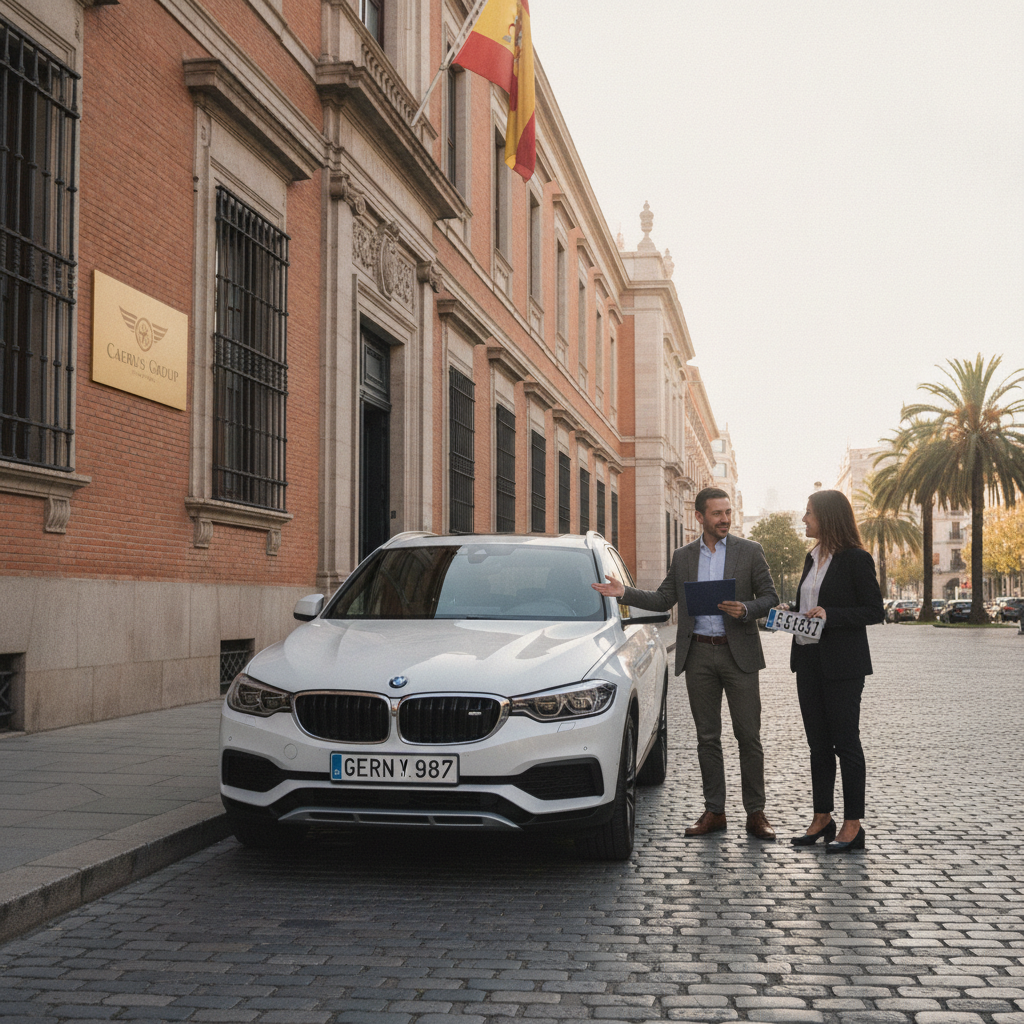
Relocating to the sunny landscapes of Spain is a dream for many, but the logistics of bringing your personal vehicle along can quickly turn into a bureaucratic maze. Whether you are moving permanently, staying for a long-term project, or have simply purchased a vehicle abroad that you wish to enjoy on Spanish roads, understanding the legal requirements is crucial. At Caerus Group, we specialize not only in premium vehicle sales but also in navigating the complex waters of Spanish administration. In this guide, we will break down exactly how to register a foreign car in Spain to ensure your transition is as smooth as possible.
The Importance of Legal Compliance
Driving a vehicle with foreign license plates in Spain is permitted for a limited period, typically up to six months for tourists. However, if you become a legal resident, the law requires you to register your vehicle with the Spanish authorities within 30 days of obtaining your residency status. Failing to do so can result in heavy fines and even the impounding of your vehicle. Knowing how to register a foreign car in Spain is not just about following the rules; it is about protecting your investment and ensuring your peace of mind while driving through the beautiful Spanish regions.
Step 1: Gathering the Essential Documentation
Before you even approach a government office, you must ensure your paperwork is in order. The Spanish "Tráfico" (DGT) is notoriously strict regarding documentation. You will generally need the following items:
First, the original vehicle title and registration documents from the country of origin. Second, a valid form of identification, such as your passport and your NIE (Número de Identidad de Extranjero). Third, proof of ownership, which is usually the original sales invoice or a contract of sale translated into Spanish if necessary. Finally, you will need a certificate of conformity (CoC), which proves the vehicle meets European technical standards. If your car does not have a CoC, you may need to undergo a specific technical inspection to create a "Ficha Técnica."
Step 2: Passing the Technical Inspection (ITV)
Every foreign vehicle entering the Spanish system must pass a specialized Technical Vehicle Inspection, known as the ITV (Inspección Técnica de Vehículos). This is not a standard annual check; it is a more rigorous "homologation" inspection to ensure the car complies with Spanish safety and environmental regulations. Even if your car recently passed an inspection in the UK, Germany, or France, it must still undergo the Spanish ITV to generate the Spanish Technical Card (Tarjeta de ITV).
During this process, engineers will verify the VIN (Vehicle Identification Number), engine specifications, CO2 emissions, and lighting systems. It is common for cars from non-EU countries to require modifications—such as changing the headlights—to meet European standards. At Caerus Group, we often advise our clients to have their vehicles pre-inspected by our mechanics to avoid any surprises at the ITV station.
Step 3: Settling the Necessary Taxes
One of the most complex parts of how to register a foreign car in Spain involves the Tax Agency (Agencia Tributaria). There are several taxes to consider, and the amount varies significantly based on the vehicle's age and its CO2 emission levels.
The primary tax is the IEDMT (Impuesto Especial sobre Determinados Medios de Transporte), often referred to as the "Registration Tax." If your car has high emissions, this tax can be substantial. However, if you are moving to Spain as a resident and registering the car as part of your "change of residence," you might be eligible for an exemption, provided you meet specific deadlines and criteria. Additionally, you must pay the "Impuesto de Circulación" (Road Tax) to the local town hall (Ayuntamiento) where you are registered.
For more detailed information on tax brackets and official forms, you can visit the official Spanish Tax Agency website.
Step 4: Final Registration with the DGT
Once the taxes are paid and the ITV is passed, the final step is to submit your application to the Dirección General de Tráfico (DGT). You will need to pay a registration fee and present all the accumulated documents: the ITV card, proof of tax payment, your ID, and the foreign registration papers. Once the DGT processes your application, they will issue your new Spanish registration number and the "Permiso de Circulación" (the vehicle’s logbook).
With this document in hand, you can finally head to an authorized plate maker to have your Spanish license plates printed. Remember, you must also notify your insurance provider immediately to switch your policy to the new Spanish plates, as driving without valid insurance is a serious offense.
Why Partner with Caerus Group?
If the process described above sounds daunting, you are not alone. Between language barriers, varying regional regulations, and the need for appointments that can take weeks to secure, many people find the process overwhelming. This is where Caerus Group steps in. As a dedicated car dealership and registration specialist in Spain, we take the weight off your shoulders.
We handle the entire end-to-end process: from collecting your vehicle and taking it to the ITV station to managing the tax filings with the Spanish Treasury and securing your final plates from the DGT. Our team of experts ensures that every "i" is dotted and every "t" is crossed, preventing costly delays or rejections. When you choose Caerus Group, you aren't just getting a service; you are getting a partner who understands the value of your time and your vehicle.
Conclusion
Learning how to register a foreign car in Spain is an essential step for any expatriate or car enthusiast bringing a vehicle into the country. While the bureaucracy can be thick, following the steps of documentation, inspection, taxation, and final registration will eventually get you on the road legally. Whether you decide to tackle the "papeleo" yourself or hire a professional firm like Caerus Group to manage the transition, ensuring your vehicle is correctly registered is the best way to start your Spanish adventure on the right foot. Enjoy the drive!